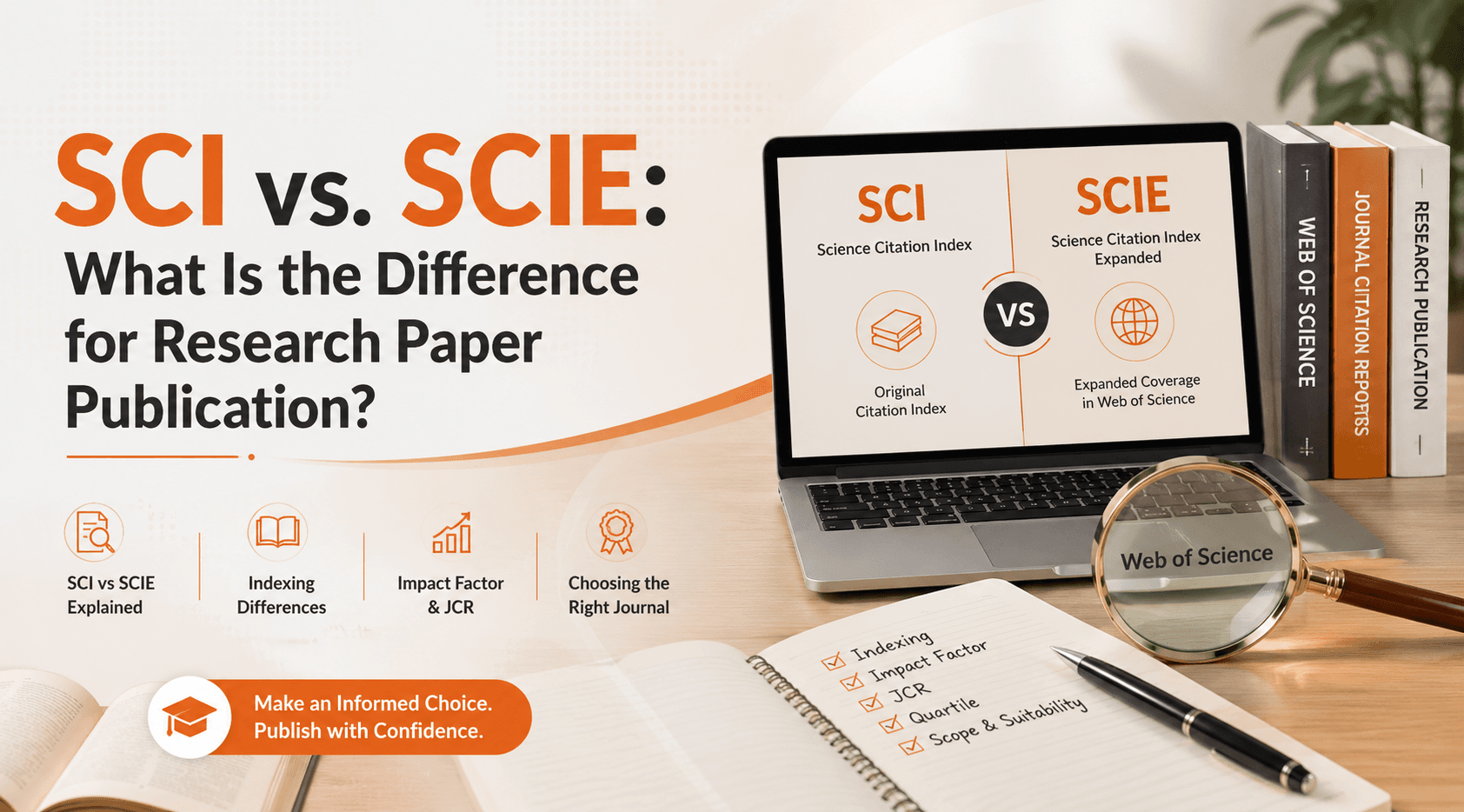
If you are intending to publish a paper for research, you might have heard about the terms such as SCI, SCIE, Web of Science, Impact Factor, and JCR.
These terms may seem confusing at first. You might even find some journals under the name of “SCI journals” or “SCIE indexed journals” and ask yourself:
- Are SCI and SCIE the same?
- Is one better than the other?
- Which one should I choose for my research paper?
These are standard queries that are made by PhD students, research scholars, and those who are writing their first author papers.
In short, whilst the history of the two is different, the modern choices of SCI and SCIE are not entirely distinct. SCIE is the Science Citation Index Expanded, which is also part of Web of Science Core Collection. Clarivate assesses journals prior to adding them into its Web of Science collections.
Rather than comparing the advantage of SCI vs. SCIE, it is more beneficial to look at the recent indexing position of the journal, whether it is appropriate for the research, and whether it is accepted by the university.
Let's take it one step at a time to understand this.
What Is SCI?
SCI stands for Science Citation Index.
It is a type of citation index that has been developed to facilitate the search for scientific research papers and to view how research papers are being cited by other researchers.
SCI has been established a long time ago, so the word SCI is still very popular in academic publishing.
Historically, SCI was related to a more limited, but narrower, range of scientific journals. Subsequently, the Science Citation Index Expanded (SCIE) was introduced to expand its coverage.
This history is one of the primary sources for the comparisons of SCI and SCIE to this day.
One can find numerous websites on the web that have the word “SCI” in their name, indicating a journal that has high academic recognition. But, don't just take an SCI claim on the word of a journal that writes it up on their website.
Always confirm the actual Web of Science condition of a journal by checking the official websites of Clarivate.
What Are SCI Indexed Journals?
So, what are SCI indexed journals?
In simple words, the journals that are indexed in the SCI are journals that are associated with the Science Citation Index. But the terms “SCI indexed journal” are used too loosely in present times by both researchers and publishers.
This is where newbies can get lost.
A journal may write:
- SCI indexed
- SCI journal
- SCI-Expanded
- SCIE indexed
- Web of Science indexed
These terms are not always comprehensive enough to indicate the actual current indexing status.
For this reason, don't select a journal only because you see the words SCI indexed journals on its website.
Rather, view the latest entry in the journal in the official Web of Science resources.
What Is SCIE?
SCIE stands for Science Citation Index Expanded.
SCIE can be viewed as the extended scientific citation index, covering a wide range of scientific journals and research.
SCIE is a part of the Web of Science Core Collection. As stated above, SCIE is one of its big indexes for scientific research now provided by Clarivate.
Just because a journal is published doesn't mean that it is automatically SCIE indexed.
Before a journal is added, it has to be evaluated.
Clarivate uses quality criteria and, in some cases for collections, impact criteria to assess journals.
Therefore, when researchers are searching for journals for research paper publication, they will be interested in finding SCIE indexed journals.
The easiest way to understand SCI vs SCIE is to look at their history first. SCI was the original Science Citation Index. SCIE stands for Science Citation Index Expanded and was developed to provide broader coverage. The important thing to remember is that this is not a simple case of “SCI is better and SCIE is worse.” The current Web of Science structure is more important than the historical comparison. This is where many researchers get confused. You may find an article or a journal website saying: “Our journal is SCI indexed.” However, what does it really mean? SCI has been in use for decades with academic publications, and many researchers and publishers still use it. For a researcher picking a journal these days, however, it is more useful to review the journal's current coverage in the Web of Science, particularly from the standpoint of whether it is covered by SCIE or not. The Web of Science Core Collection is currently identified by Clarivate as an index which includes SCIE. If your university requires you to have an “SCI journal,” then do not immediately begin searching for a separate “SCI list”. First of all, find out what “SCI” is actually defined as in your university. It may mean: These are other requirements. Now let's get on to the most important question to researchers: What does SCI vs SCIE mean when I want to publish my research paper? Most researchers don't care about the label; it is what is inside the package that matters. You should ask: The journal might be a good journal to index, but it might not be the journal where your paper is appropriate. For instance, if you're doing research on education, you're looking for a journal that publishes education-related research. Picking a journal just for the metric doesn't mean it's the right one to submit. Which is why the choice of journal should always go beyond the index label and consider scope and suitability. One of the questions that many researchers ask is: SCI vs SCIE: Which is better? The simple answer is: not to consider it a simple competition between two current journal choices. The SCI index is a historic index and the SCIE index is an ongoing index in the Web of Science Core Collection. If the purpose of the research paper is to publish, it should be based on the current status and quality of the journal. Here are a few things to check out: So the first, and most important thing to note is that it is not just the website with “SCI” written on it that is best. It is the journal you can use for your research and fulfill your academic needs. This is another misconception. Some researchers think: SCIE = High Impact Factor This is not always the case. SCIE is an index. The Journal Impact Factor is a journal metric. They are associated with the greater Web of Science ecosystem, but they are not identical. If you are reading a journal, you may wish to find out: These questions are to be checked individually. Note that not all SCIE journals are created equal or have the same Impact Factor or ranking. If these four terms are confusing you, don't worry. Here is a simple explanation. For example, you may hear someone say: “This is an SCIE journal and it is Q1.” Here, SCIE tells you about its indexing, while Q1 tells you about its position within a particular subject category. These are two different pieces of information. If you're looking for something to record in, you might be wondering: How to check SCI or SCIE journal? It is one of the most vital things you must grasp prior to submitting your paper. Don't rely solely on: Rather, check the journal by the official Clarivate sources.
First, write down the exact name of the journal. An ISSN is a number identical to another number assigned to a journal. If you have the ISSN, use it when checking the journal. It can assist you in finding the right journal. Locate the journal in Clarivate's official Master Journal List. It is one of the most secure methods to verify its Web of Science coverage. Do not stop once the journal name has been found. Examine the collection in which the journal is found. If you require SCIE, please be sure to use the journal that is included under SCIE. Ideally, indexing can change, so you shouldn't rely on a past screenshot or list. See the latest details. If the journal claims to have an Impact Factor or particular quartile, verify those claims through the appropriate Clarivate resources. Yes. This is something many researchers don't know. The addition of a journal to the index does not guarantee that it will continue to be included in the same collection in the future. Clarivate explains that Web of Science collections are dynamic and journals can be re-evaluated. A journal's coverage can change if it no longer meets the required standards. This does not imply that you should depend on: “The journal was indexed in SCIE five years ago.” Instead, check: “Is the journal currently indexed in SCIE?” This is particularly important when you have to publish a paper for a PhD requirement, promotion, research project, or funding requirement. This is just the beginning of finding the SCIE indexed journals. Take some time to review the journal prior to submitting your research paper. Read the aims and scope of the journal. The paper should be appropriate for the subjects of the journal. Look at recently published papers. Ask yourself: This can often be a more informative indicator of journal suitability than just the name of the journal. Any journal should provide good information on the review process of submitted papers. Beware of a journal that promises quick acceptance or publication without meaningful review. Consider relevant JCR information, Impact Factor, and quartile if available. Use common sense when comparing numbers in totally dissimilar subject areas. Check if the journal has an APC or other publication fee before submitting your article. You don't want to find out after paper acceptance that you have a big surprise charge. When searching for clear information about: Always check the status of the indexing. For publication in a PhD or promotion, check your institution's current publication guidelines if you are submitting your paper for a PhD or promotion. It is a situation a number of PhD scholars encounter. Your college or university might inform you: “You need an SCI publication.” The issue is that this wording might not be clear enough for you to know exactly what the university is looking for. For instance, the university may actually require: Therefore, it is crucial to follow the guidelines of your university before embarking on your SCI journal publication. If the requirement is not stated, discuss with your research department or supervisor whether the journal in question is now indexed in SCIE. Explanation of this is better done prior to submission than after publishing. The SCI and SCIE have also made opportunities available for false claims of publication. You may come across advertisements saying: Beware of such statements. The status of a journal for indexing should be established independently. Clarivate's Web of Science Core Collection is determined through an editorial evaluation process. If someone says: “Pay us and we will guarantee SCIE indexing.” This should immediately raise a red flag. The same goes for a journal that has a Web of Science logo but is not included in the official database. Fact: They are different in history, but researchers should concentrate on the coverage of the journal in Web of Science, not on the level of the journal in the 20th century. Fact: A website with the words “SCI indexed” doesn't necessarily mean current coverage. Fact: SCIE indexing and Impact Factor are different things. Fact: Web of Science coverage can be re-evaluated and changed. Fact: A journal should also match your research topic, audience, publication requirements, and budget. Before submitting your paper for SCI journal publication or SCIE journal publication, use this quick checklist: Taking 15–20 minutes to check these details can save you from a lot of trouble later. Frequently Asked Questions What is the difference between SCI and SCIE? SCI stands for Science Citation Index, while SCIE stands for Science Citation Index
Expanded. SCI has historical importance in scientific indexing, while SCIE is part of the
current Web of Science Core Collection. For journal selection today, researchers should
focus on the journal's current indexing status. Is SCIE better than SCI for research paper publication? It is not correct to simply say that one is better than the other. For current research paper
publication, researchers should check the journal's SCIE status, research scope, quality,
journal metrics, and whether it meets their university's requirements. How can I check whether a journal is SCI or SCIE indexed? You can check the journal through Clarivate's official Master Journal List. Search for the
journal using its title or ISSN and check its current Web of Science collection. Avoid relying
only on the indexing claims displayed on a journal's website. Does SCIE indexing mean that a journal has an Impact Factor? No. SCIE indexing and Impact Factor are different things. SCIE refers to a journal's indexing
coverage, while the Journal Impact Factor is a separate journal-level metric. Always verify
Impact Factor claims through the appropriate Clarivate source. Can a journal lose its SCIE indexing? Yes. Web of Science coverage can be re-evaluated, and a journal's indexing status may
change if it no longer meets the required standards. Researchers should therefore check the
journal's current status before submitting their research paper.SCI vs SCIE: What Is the Difference?
SCI vs SCIE at a Glance
SCI SCIE Science Citation Index Science Citation Index Expanded Original citation index Expanded version Has a long history in academic publishing Current Web of Science Core Collection index Commonly seen in older academic discussions Current and important indexing term for scientific journals Often used as a general term today Commonly used in current journal indexing discussions Is SCI Still a Separate Index Today?
SCI vs SCIE for Research Paper Publication
SCI vs SCIE: Which Is Better?
Does SCIE Indexing Mean the Journal Has a High Impact Factor?
SCIE, JCR, Impact Factor and Quartile Explained Simply
Term Simple meaning SCIE A Web of Science index that includes scientific journals JCR A resource used to see journal-level metrics and rankings Impact Factor A metric used to measure citation activity at the journal level Quartile Shows how a journal ranks compared with other journals in its subject category
How to Check SCI or SCIE Journal?
Step 1: Find the Journal Name
Step 2: Find Its ISSN
Step 3: Search the Master Journal List
Step 4: Check the Collection
Step 5: Check the Current Status
Step 6: Check JCR Information Separately
Can a Journal Lose Its SCIE Indexing?
What Should You Check Before Choosing an SCIE Journal?
1. Check the Scope
2. Check Previous Articles
3. Check the Peer-Review Process
4. Check the Journal Metrics
5. Check Publication Fees
6. Check Publication Ethics
7. Check the Current Indexing
8. Check Your University's Rules
What If Your University Requires an “SCI Journal”?
Be Careful With Fake SCI and SCIE Claims
Common SCI vs SCIE Myths
Myth 1: SCI and SCIE are simply two different levels today.
Myth 2: Every SCI journal is currently indexed.
Myth 3: Every SCIE journal has a high Impact Factor.
Myth 4: Once a journal is indexed, it stays indexed forever.
Myth 5: The highest Impact Factor is always the best choice.
SCI/SCIE Journal Publication Checklist