Scientific research is built around an important idea: when researchers investigate the same question carefully, their findings should be reliable enough to be tested again. But sometimes, when another research team repeats a study, the results are different or the original finding cannot be reproduced.
This is right at the core of the reproducibility crisis.
Not all scientific studies are faulty. Research is an activity that involves a different set of participants, settings, instruments, data sets, and analytical decisions. If critical findings continue to fail to replicate in independent research, however, it is important to examine the design and reporting of research.
This is an ongoing topic in 2026. Only about half of the studies analyzed in a seven-year initiative to replicate roughly 3,900 papers in the social sciences were repeatable, according to the researchers.
So, why don't research results replicate and what can researchers do about it?
What Is the Reproducibility Crisis?
The issue of reproducibility in research is the challenge faced by researchers to repeat or replicate results of previously published studies.
This may be caused by poor study design, small samples, publication bias, selective reporting, statistical errors, or difficulty with access to research data, code, or other tools and methods.
Be careful not to assume that each failure in replication is a sign that the original study was incorrect. A result may vary due to differences in the population, environment, measurement method or research conditions.
The idea of research reproducibility is not to get every study with the same numbers. It's to ensure research is transparent, reliable, and open for other researchers to examine and test the results.
Reproducibility vs. Replicability: What Is the Difference?
These two terms are closely related but are not exactly the same.
| Term | Meaning | Example |
|---|---|---|
| Reproducibility | Obtaining consistent results using the original data, methods, or analysis | Using the original dataset and code to obtain the reported result |
| Replicability | Testing the same research question using new data or participants | Conducting the experiment again with a new group |
For example, a researcher might successfully reproduce the original statistical analysis using the same dataset. However, when another team conducts the study with new participants, the effect might be much smaller.
Understanding this difference is important when discussing reproducibility in research.
What Does the Reproducibility Crisis Look Like in 2026?
The research reproducibility crisis is not simply a historical issue. Recent large-scale replication work continues to show problems.
A seven-year project involving thousands of social-science papers found that only around half of the studies tested could be replicated.
Earlier work has also shown that replicated effects can be considerably smaller than the effects reported in the original studies. The Many Labs 2 project, for example, found that the typical replicated effect across 28 studies was much smaller than the original effect.
These findings do not mean that all published research should be questioned. Instead, they show why research replication is an important part of scientific progress.
Why Do Research Findings Fail to Replicate?
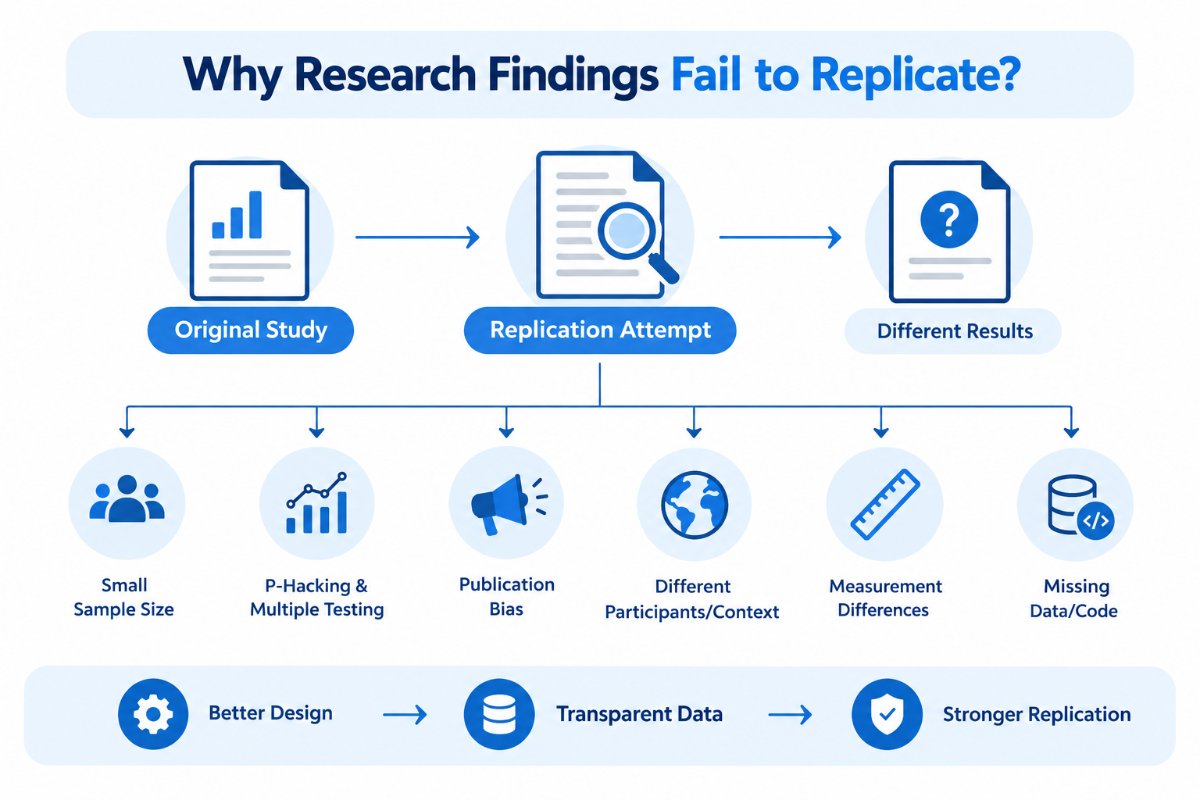
There is no single reason behind the replication crisis. Several problems can contribute to a finding changing when it is tested again.
Common Causes of Replication Failure
| Cause | What Happens | Impact on Research |
|---|---|---|
| Small sample size | Results are more affected by random variation | Effects may appear larger or disappear later |
| Low statistical power | Real effects may not be detected reliably | Increases uncertainty in findings |
| Publication bias | Positive findings are published more often | Literature may look more consistent than it is |
| P-hacking | Multiple analyses are tried until a significant result appears | Increases the chance of false-positive findings |
| Measurement differences | Different tools or definitions are used | Studies may produce different results |
| Researcher flexibility | Different analytical decisions lead to different outcomes | Results may be difficult to reproduce |
| Missing data or code | Other researchers cannot fully repeat the analysis | Verification becomes difficult |
| Different research contexts | Participants, locations, or conditions change | Findings may not generalize |
1. Small Samples and Low Statistical Power
Small studies can produce unstable results. An effect may appear stronger than it really is simply because of random variation.
Low statistical power can also make it difficult to detect a genuine effect.
Researchers can reduce this problem by conducting appropriate sample-size and power calculations before beginning a study.
2. Poor or Different Research Conditions
Even when researchers follow the same general methodology, small differences can affect the results.
These may include:
- Participant recruitment
- Laboratory conditions
- Equipment
- Timing
- Intervention delivery
- Data collection procedures
This is especially important in research involving humans or complex experimental environments.
3. Publication Bias
Not every completed study becomes a published paper.
Positive and statistically significant findings have historically received more attention than negative or null results. This can make the published literature appear more consistent than the complete body of research actually is.
When unsuccessful studies remain unseen, researchers may unknowingly build new research on an incomplete evidence base.
4. P-Hacking and Multiple Testing
Researchers often have legitimate choices when analyzing data. They may choose different variables, statistical models, exclusions, or subgroups.
The problem occurs when researchers repeatedly try different analyses until they find a significant result and then present that result without clearly explaining the analytical process.
This is commonly known as p-hacking.
A significant p-value alone does not guarantee that a finding is reliable. Researchers should also consider effect sizes, confidence intervals, sample size, and the overall evidence.
5. Researcher Degrees of Freedom
Researcher flexibility is another important issue in research replication problems.
A dataset may allow researchers to make many reasonable analytical decisions. Different choices can sometimes lead to different conclusions.
This is why transparent reporting matters. Researchers should explain important decisions rather than presenting the final analysis as if it were the only possible approach.
6. HARKing and Changing the Research Story
HARKing means developing or presenting a hypothesis after seeing the results.
It's not wrong science to explore unexpected findings. Indeed, any new, unanticipated observations may result in an interesting new research question.
The problem is that if someone discovers something while conducting a study, and presents it as a prediction prior to the study, then it is not really an exploratory discovery.
Good reporting assists readers to see how convincing the evidence actually is.
7. Measurement Differences
There are two studies that measure the same thing but rely on different instruments or definitions.
For instance, a researcher looking at stress might employ a different questionnaire or measure of stress. The final results can be affected by even slight variations.
Clear and consistent measurement is thus a requirement for reliable reproducibility in scientific research.
8. Different Participants and Contexts
What is found in one population does not necessarily mean what it does in another population.
Research results may be different from one person to another due to age, culture, geography, socioeconomic conditions, education and more.
A replication might thus indicate that a result was found because of a context rather than that the original study was wrong.
Does a Failed Replication Mean the Original Study Was Wrong?
Not necessarily.
There are a number of reasons for a failed replication:
- The original effect was exaggerated.
- The new study used a different population.
- Research conditions were different.
- Measurement methods changed.
- Random variation affected the original result.
- One of the studies contained a methodological or statistical problem.
This is because replication in research is not a straightforward way to determine if a paper is 'right' or 'wrong'.
When researchers replicate, they are able to get a clearer picture of the strength, stability, and generalizability of the finding.
The Problem of Missing Data and Code
In modern reproducible research, it is more than often important that the paper is not the only thing.
Research may involve:
- Raw datasets
- Statistical scripts
- Programming code
- Software packages
- Data-cleaning procedures
- Computational environments
If these materials are not available, then another researcher might have the paper, but he or she may not be able to do the analysis.
NewsRx coverage pointed to the difficulty in verifying research data due to missing data and digital research materials.
This is becoming more crucial as research becomes more "Computational" and data-driven in nature.
Does Peer Review Guarantee Reproducibility?
No.
Peer review is important, but peer review is not replication.
The reviewer may note issues with methodology, statistics or interpretation. But, reviewers are not likely to reproduce the complete experiment before it is published.
The paper may be accepted for publication but be rejected upon replication by another research group.
There are multiple layers of checks that must be carried out for the scientific reliability, such as peer review, transparent reporting, independent replication as well as ongoing checks, including after publication.
Can Open Science Improve Research Reproducibility?
Open science has emerged as a key solution to the research reproducibility crisis.
Useful practices include:
- Preregistration
- Open data
- Open code
- Registered reports
- Transparent methodology
- Preprints
- Sharing research materials
- Reporting null or negative findings
Preprints can help researchers get feedback prior to formal publication and help make research results more accessible. But preprints cannot fix problems with poorly designed research and/or weak statistical methods.
Likewise, it is not enough to just share data and expect scientific reproducibility if the analysis process is not well documented.
What Are Registered Reports?
Registered Reports aim to mitigate some types of publication and reporting bias.
A standard research process is typically:
Registered Reports focus more on the nature of the research questions and methods prior to results:
This may limit the willingness to alter the hypotheses or analytical decisions because the early results were not anticipated.
The overall objective is to give more weight to the extent to which a study was well designed, not just on the basis of its exciting findings.
How Can Researchers Make Their Studies More Reproducible?
Researchers can enhance research reproducibility by taking action during the research process.
Before the Study
- Define the research question clearly.
- Conduct an appropriate power analysis.
- Predefine important outcomes.
- Preregister hypotheses or analysis plans when appropriate.
During the Study
- Follow a documented research protocol.
- Record changes and deviations.
- Preserve raw data.
- Document research conditions and measurement procedures.
During Analysis
- Keep analysis code organized.
- Record software and package versions.
- Explain data-cleaning and exclusion decisions.
- Separate exploratory findings from confirmatory findings.
Before Publication
- Report methods in sufficient detail.
- Share appropriate data and code where possible.
- Report important null findings.
- Clearly explain limitations.
- Distinguish unexpected findings from hypotheses developed before data collection.
These practices enable researchers to create research that other researchers can comprehend, review, and expand upon.
What Is the Future of Research Reproducibility?
A single solution to the reproducibility crisis is not likely to solve the problem. We need change in the whole research process to improve the reliability of the research.
Study designs and reporting need to be improved. Publication of data and code in journals and increased publication of replication studies. Another alternative is to reduce the pressure on universities and funders to focus on numbers of publications and increase focus on research quality.
Comparing the evidence available in 2026 with the evidence available a decade ago, it is also clear that there remain issues with problems of research replication, but there are more tools than 10 years ago to address these issues.
Perhaps the biggest change will be the way replication is considered. Replication will no longer be seen as an attack on researchers; rather, it will be seen as a necessary component of scientific advancement.
A finding is more worthwhile when it has been subjected to careful testing by other persons. But when it doesn't, that outcome can still be useful as a way to show researchers the scope of the initial assertion.
Reproducibility in research is all about making science more accessible, verifiable and reliable over time.
FAQs
What is the reproducibility crisis?
Reproducibility is a crisis in the field of research, where results of published research are difficult to reproduce or replicate. It may arise due to method, statistical, reporting, publication or incentive issues.
Why do research findings fail to replicate?
Common reasons include small samples, low statistical power, publication bias, p-hacking, measurement differences, researcher flexibility, missing data or code, and differences in participants or research conditions.
What is the difference between reproducibility and replicability?
Reproducibility typically entails getting the same results from the same data, procedures, or analyses. Replicability is the process of a new study to see if the finding is replicated with new data or new participants.
Does failed replication mean the original research was wrong?
No. If the replication fails, it could be due to a greater effect size, different research conditions, differences in measurement, random variation, or methodological issues.
How can researchers improve reproducible research?
Better study designs, appropriate sample size, preregistered studies, transparent analysis, detailed documents, and the appropriate sharing of data, code, and research materials, can improve the research reproducibility.
Is the replication crisis still a problem in 2026?
Yes. Despite the success of a large-scale replication effort in the past few years, there remains much to be done, and open data, preregistration, registered reports, and transparent reporting are helping to address the challenges of doing better research.