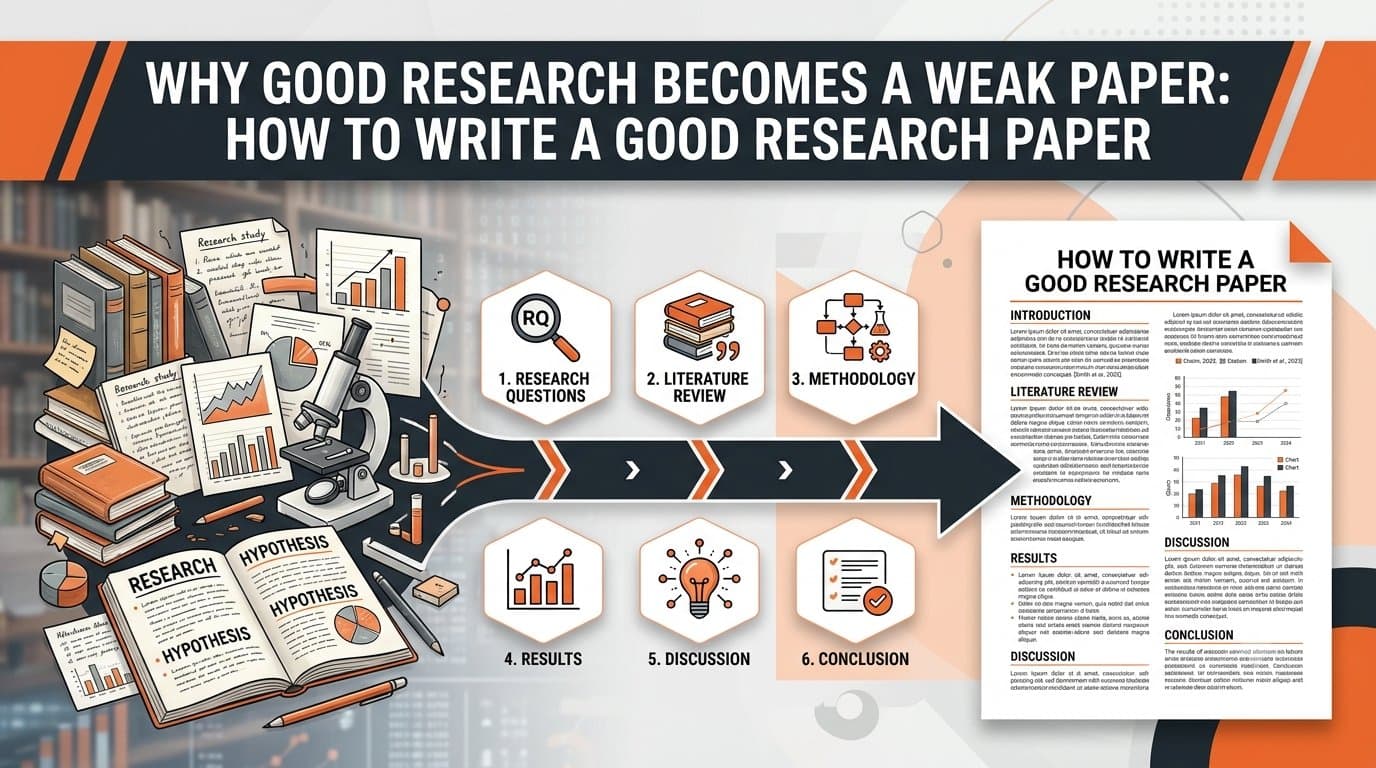
How to Write a Research Paper: Turning Good Research Into a Strong Manuscript
Good research does not automatically become a good research paper.
A researcher can spend months gathering data, reading research, running experiments, analysing data and coming up with a good research idea. However, once it's written, the paper may seem disjointed and confusing, or less compelling than the research itself.
This is where a lot of researchers have difficulties in writing their research papers.
Not all the time the quality of the research is the problem. At times, it's how that research is made known. Unclear research question, literature review is a summary of previous research studies, difficult-to-follow methodology, or a discussion that restates the results of the study can detract from a strong study.
If you're eager to know how to write a research paper, it's not only a matter of formating. It is making a clear link between your research question, evidence, analysis, findings and contribution.
Here are some tips for writing a good research paper, why sometimes good research turns into a poor manuscript, and how to enhance overall research paper quality prior to submission.
What Makes a Good Research Paper?
The purpose of a good research paper is more than just to present information. It should lead the reader through a research problem and make it clear how this problem is answered by that research.
A good paper generally contains:
- A focused research question
- A clearly defined research gap
- Relevant and well-organised literature
- A suitable research methodology
- Clearly presented results
- Meaningful research paper analysis
- A discussion that explains the importance of the findings
- A clear research contribution
- Accurate citations and references
- Logical structure and readable language
When writing a paper, complicated language is not necessary to make it look academic. Too much complexity can render a good study incomprehensible, in fact.
Measuring a research paper is the ability of the reader to know what you investigated, why you investigated it, how you conducted the investigation, what you found and why it is important.
Why Does Good Research Become a Weak Paper?
This is one of the least discussed issues in academic publications.
Researchers tend to concentrate on doing the study and writing it up afterwards. By then they have a considerable amount of information to include. The manuscript can then get "stuffed" with detail, without having a central thesis/argument.
Good research can be undermined by a number of common weaknesses.
1. The Research Question Is Not Clear
If the reader isn't able to quickly grasp what the study is attempting to answer, the paper is hard to follow.
Not all broad topics are good research questions.
Broad topic:
More focused question:
The second question provides a greater sense of direction for the paper. It also guides the literature review, data collection and analysis.
2. The Research Gap Is Too Vague
Another common weakness is a research gap that simply says:
This is not much information to the reader.
A larger gap accounts for:
Your literature review should, therefore, have a direction. It should not turn into a laundry list of what others have stated.
Literature Review: From Summary to Synthesis
A bad literature review may be something like this:
Many citations can be there, but it is not clear to the reader what the literature overall says.
A better literature review will make comparisons and connections with previous research.
For example:
It's as easy as that: summary makes readers aware of what others have done; synthesis helps them understand what it all means.
Build a Clear Research Paper Structure
A strong research paper structure helps readers understand your argument without getting lost.
Many journal articles follow an IMRAD-style structure:
Depending on the discipline and journal, you may also have a separate literature review, conclusion, abstract, keywords, references, tables, figures, or supplementary material. The exact structure should always follow the requirements of your target journal.
A useful way to think about your paper is:
| Section | Main Question |
|---|---|
| Introduction | What problem are you addressing? |
| Literature Review | What is already known and what is missing? |
| Methodology | How did you investigate the problem? |
| Results | What did you find? |
| Analysis | What do the findings show? |
| Discussion | What do the findings mean? |
| Conclusion | What should the reader take away? |
The sections should not work independently. They should work as one connected argument.
Make Your Introduction Build a Case
The introduction should introduce the reader from the general to the specific topic of study.
A useful flow is:
A frequent error is dedicating too much attention to the general background and not enough to the actual research problem.
At the conclusion of the introduction the reader should be able to:
- What is the problem?
- What is already known?
- What is still unknown?
- Why does that gap matter?
- What will your study investigate?
The logical order of the paper makes it easier to follow and gives the rest of the paper a direction.
Write a Research Methodology That Builds Trust
Research methodology isn't just a chunk of text in which you explain what you did. It should enable readers to comprehend the methodology used and the appropriateness of the chosen approach.
This may consist of:
- Research design
- Study population or sample
- Data collection methods
- Instruments or materials
- Variables or measures
- Data analysis techniques
- Ethical considerations
- Relevant inclusion or exclusion criteria
Good research can appear weak when it's presented in a poor way since readers can't assess the research's production.
Ask yourself:
If it is a no, then the methodology needs to be worked out more.
Present Research Paper Results Clearly
The research paper results should answer an important question:
The results should be presented as a set of responses to the research question(s) instead of a series of numbers.
Tables, graphs, charts, and figures may be very helpful when they help make complex findings understandable. Every visual should explain a specific idea and shouldn't restate what has been explained in the text.
For instance, if you have 10 numerical values in a long paragraph, a well-designed table can enable readers to see the important pattern right away.
Do not draw any conclusions in the Results section, however. Leave deeper interpretations for the Discussion.
Research Paper Analysis: Go Beyond Reporting Data
The analysis of the collected evidence to answer the research question is called research paper analysis.
But analysis does not equal data presentation.
If your study indicates that one group did better than another, what should you do?
The outcome reveals the outcome of the events.
Help explain:
- How large was the difference?
- Was it statistically or practically meaningful?
- Which factors may explain the difference?
- Does it support the original research objective?
- Does it agree with previous studies?
Now is the time your research begins to take the form of an argument, not just observations.
Write a Research Paper Discussion That Adds Meaning
One of the areas where a good study can become a bad paper is in the research paper discussion.
One of the frequent errors is being repetitive in the Results section:
This is common knowledge to the reader.
The Discussion should address:
A helpful Discussion might include:
- Interpretation of the main findings
- Comparison with previous research
- Possible explanations for similarities or differences
- Theoretical or practical implications
- Study limitations
- Suggestions for future research
Your Discussion should also not make statements that you do not have evidence for.
Do not assume causation when your research indicates only association – unless your study design is used to support the assumption of causation.
Make Your Research Contribution Obvious
Sometimes the researchers take for granted that readers will automatically know what is important in their research.
That is risky.
Your essay must answer the following question:
You can help by:
- New evidence
- A new population or geographical context
- A new interpretation
- A new methodology
- A new application of an existing approach
- Evidence that challenges previous findings
Originality isn't the same thing as changing the field, so you don't have to go out on a limb to say your research "changes the field."
On other occasions, a more concise contribution is more convincing.
Weak Paper vs. Strong Paper
One of the easiest ways to understand research paper quality is to compare how the same research can be communicated differently.
| Weak Paper | Strong Paper |
|---|---|
| Research question is broad | Research question is focused |
| Research gap is vague | Research gap is specific |
| Literature is mostly summarised | Literature is synthesised |
| Sections feel disconnected | Sections support one central argument |
| Methodology is unclear | Methodology is transparent |
| Results are presented without context | Results are organised around research objectives |
| Discussion repeats results | Discussion interprets findings |
| Contribution is implied | Contribution is clearly stated |
| Claims go beyond evidence | Claims match the evidence |
| Writing is difficult to follow | Writing is clear and logical |
The important point is that the second paper does not necessarily contain "better" research. It communicates the research more effectively.
Common Reasons for Rejection of Research Papers
Rejection is not necessarily an indicator of a bad research.
The fit of the journal, manuscript presentation, methodology, clarity, originality, or the requirements of submission may be a problem. Another reason for a manuscript's rejection is that it is not within the scope of the journal or does not satisfy the manuscripts' basic requirements.
Common reasons that cause rejection of research papers are:
- The manuscript does not fit the journal's scope
- The research question is unclear
- The research gap is not convincing
- The methodology has important limitations
- The findings do not sufficiently support the conclusions
- The manuscript lacks a clear contribution
- The discussion is weak
- References are incomplete or inappropriate
- The manuscript does not follow journal guidelines
- Language and presentation make the paper difficult to understand
That's why manuscript preparation needs to start long before you click that submit button.
How to Improve Your Research Paper Writing
Writing typically takes place through revision, not a single first draft.
A work flow is:
First Draft
Focus on getting your ideas onto the page.
Structural Revision
Check whether the sections follow a logical sequence.
Argument Revision
Ask whether every major section contributes to answering the research question.
Evidence Check
Make sure important claims are supported by appropriate evidence.
Language Revision
Remove unnecessary words, unclear sentences, repetition, and excessive jargon.
Final Proofreading
Check grammar, references, figures, tables, formatting, and journal requirements.
It can also provide a bit of a break in the manuscript prior to final review. If you're taking another look at your paper after days or weeks of working on it, you may notice inconsistencies that slip by the first read.
A Simple Formula for Strong Academic Paragraphs
It doesn't have to be every paragraph in the exact same order, but it can be helpful to structure your paragraphs like this:
Claim
What is the main point of the paragraph?
Evidence
What research, data, or observation supports it?
Explanation
What does that evidence tell the reader?
Connection
How does it relate to your research question or the wider argument?
This is particularly useful for the discussion section and the literature review.
Don't have a paragraph because you found an interesting citation. It should have a task to accomplish.
Final Manuscript Preparation Checklist
Review the manuscript one last time as as if you are a reviewer.
Ask yourself:
Research
- Is the research question clearly stated?
- Does the study address a meaningful gap?
- Are the objectives specific?
Structure
- Does the research paper structure make sense?
- Does each section naturally lead to the next?
Methodology
- Is the research methodology sufficiently explained?
- Is the selected approach appropriate?
Results and Analysis
- Are the findings presented clearly?
- Does the research paper analysis address the research objectives?
Discussion
- Does the research paper discussion explain why the findings matter?
- Are limitations acknowledged?
- Are the conclusions supported by the evidence?
Presentation
- Are tables and figures easy to understand?
- Are citations and references accurate?
- Is the writing clear?
- Have the journal's formatting and submission requirements been followed?
FAQs
1. What makes a good research paper?
A well-structured research paper should include a well-defined research question, a solid sense of research gap, suitable approach, credible evidence, coherent analysis, insightful discussion, and a properly formulated contribution.
2. How do I write a good research paper?
Begin by establishing a well-focused research question and research gap. Next, develop a logical outline, choose a suitable method, state your findings in a clear manner, discuss the findings in the Discussion, and edit carefully before sending your manuscript.
3. Why does good research sometimes become a weak paper?
Weak research can be a strong paper when the manuscript is well organised, has a clear research question, research sections are well connected, methods are well explained, results are well explained, and the research contribution is clear.
4. What are common reasons for rejection of research papers?
Common issues encountered are an unclear research question, methodological issues, insufficient originality, conclusions drawn without appropriate evidence, inadequate discussion, poor presentation and not conforming to journal submission requirements.
5. Why is manuscript preparation important?
Manuscript preparation helps transform research findings into a clear, organised, and publication-ready paper. It includes structural revision, language editing, checking references, reviewing figures and tables, and ensuring that the manuscript follows the target journal's requirements.