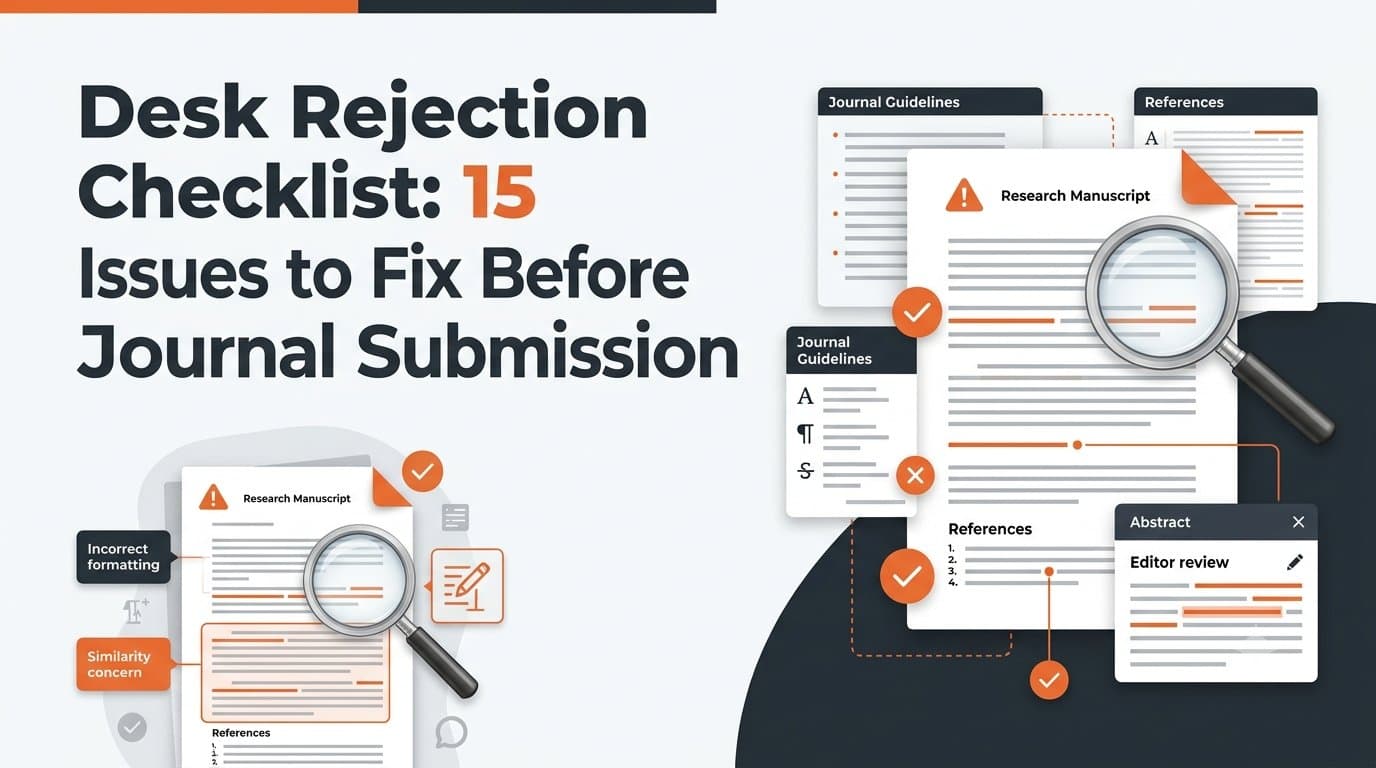
15 Common Desk Rejection Reasons and How to Avoid Them Before Journal Submission
Submitting a research paper is a major step, but submission does not always mean the manuscript will reach peer review. Before sending a paper to reviewers, editors usually check whether it fits the journal and meets its basic requirements.
If major problems are found at this stage, the editor may reject the manuscript without sending it for peer review. This is called desk rejection.
The good thing is that many common desk rejection reasons can be identified and fixed before submission. A careful final review can help you avoid simple mistakes and improve your chances of moving to peer review.
What Is Desk Rejection?
The desk rejection meaning is simple: an editor rejects a manuscript before it goes through external peer review.
This does not necessarily mean the research is poor. A manuscript can be rejected because it is outside the journal's scope, does not follow important guidelines, has an unclear contribution, or has concerns related to methodology, ethics, or presentation.
Editors may consider:
- Journal scope and relevance
- Research contribution
- Manuscript quality
- Methodology
- Ethics and transparency
- Author guidelines
- References and citations
- Required files and declarations
So, before submitting, don't just ask whether your paper is complete. Ask whether an editor could find a reason to stop it at the initial screening stage.
15 Issues to Fix Before Journal Submission
1. Wrong Journal or Scope Mismatch
A strong paper can still receive a desk rejection if it does not fit the journal.
Check the journal's aims, scope, readership, and recently published papers. Reading several recent articles can help you decide whether your research genuinely belongs there.
2. Incorrect Manuscript Type
Make sure you are submitting the correct article type.
Journals may accept original research, review articles, systematic reviews, case reports, short communications, or technical papers. Each type may have different requirements.
3. Research Contribution Is Unclear
Editors need to understand what your study adds to existing research.
Your introduction should explain:
- What problem you address
- What research gap exists
- What your study contributes
- Why the findings matter
If the contribution is difficult to identify, strengthen it before submission.
4. Title, Abstract and Conclusion Do Not Match
Your manuscript may have changed during revision, while the abstract or conclusion still describes an earlier version.
Check that:
- The title reflects the actual study
- The abstract reports the final findings
- Numbers match the Results section
- The conclusion answers the research objective
These sections should tell the same overall story.
5. Research Question or Objective Is Unclear
Your research question should be easy to identify.
There should be a logical connection between:
If the objective is unclear or the conclusion does not answer it, revise the manuscript before submission.
6. Author Guidelines Are Not Followed
Ignoring the journal's instructions is one of the easiest problems to avoid.
Check:
- Word count
- Abstract format
- Heading structure
- Reference style
- Figure and table requirements
- File format
- Supplementary material
- Blinded-review requirements
Don't assume that the format used by another journal will work for your new submission.
7. Required Reporting Guidelines Are Missing
Some research designs require specific reporting guidelines.
For example:
- PRISMA – systematic reviews
- CONSORT – randomized trials
- STROBE – observational studies
- STARD – diagnostic accuracy studies
Check whether the journal requires a reporting checklist with your submission.
8. Ethics and Consent Information Is Incomplete
For studies involving people, animals, or sensitive data, make sure the required ethics information is included.
Depending on the study, this may include:
- Ethics committee name
- Approval number
- Informed consent
- Consent for publication
- Participant confidentiality
Don't assume that obtaining approval is enough. The journal may require specific information in the manuscript.
9. Authorship, Funding or Conflict Details Are Missing
Before submission, check:
- Author names and order
- Affiliations
- ORCID information, if required
- Corresponding author
- Author contributions
- Funding statement
- Conflict-of-interest declaration
The information in your manuscript and submission system should be consistent.
10. Plagiarism or Duplicate Submission Concerns
Make sure the manuscript is original and is not being reviewed by another journal at the same time.
Check for:
- Reused text from previous publications
- Duplicate publication
- Excessive self-plagiarism
- Reused figures or tables
- Simultaneous submission
If your current paper builds on earlier work, explain the relationship clearly where required.
11. References Are Incorrect or Poorly Matched
Your references should be carefully checked before submission.
Make sure:
- Every citation appears in the reference list
- Every reference is cited
- Author names and publication years are correct
- DOI information is accurate
- The required citation style is followed
- Relevant recent studies are included
It is also worth checking whether important cited papers have been retracted or corrected.
12. Methods and Results Do Not Line Up
Look for inconsistencies between your methodology and findings.
Check whether:
- Sample sizes are consistent
- Statistical methods match the study
- Tables contain the same numbers as the text
- Results match the abstract
- Conclusions are supported by the findings
A paper can look polished but still raise editorial concerns if its core sections do not connect logically.
13. Figures, Tables and Supplementary Files Have Problems
Before uploading your files, check:
- Correct numbering
- Complete captions
- In-text references
- Required resolution
- Correct file format
- Supplementary files
- Permissions, where applicable
For example, if the manuscript refers to "Table 3," make sure Table 3 actually exists and contains the correct information.
14. Submission Metadata Does Not Match
Check the details entered in the submission portal against your manuscript.
| Information | What to Check |
|---|---|
| Author names | Same in both |
| Author order | Correct |
| Affiliations | Updated |
| ORCID | Correct |
| Corresponding author | Same |
| Funding | Consistent |
| Conflict statement | Consistent |
If the journal uses double-blind review, also remove identifying information from the manuscript and document properties where required.
15. Cover Letter or Submission Package Is Incomplete
Your cover letter should be specific to the journal rather than a generic template.
Briefly mention:
- Manuscript title
- Main contribution
- Why it fits the journal
- Originality of the work
- Any declarations requested by the journal
Then make sure you have uploaded every required file, including figures, supplementary material, reporting checklists, and forms.
Desk Rejection vs Technical Return vs Peer-Review Rejection
These three outcomes are often confused.
| Decision | Meaning |
|---|---|
| Technical return | Missing or incorrect files/details need to be corrected. |
| Desk rejection | Editor rejects the manuscript before external peer review. |
| Peer-review rejection | The paper has gone through review and is rejected after editorial/reviewer assessment. |
Not every formatting issue automatically results in desk rejection. The process depends on the journal and the seriousness of the problem.
How to Avoid Desk Rejection
The trick to avoiding desk rejection is to eliminate avoidable issues before they reach the desk.
A straightforward final work is:
Do this review as much as possible before the actual submission date, not in a rush.
How to Deal With Desk Rejection of an Article
Don't take a desk rejection as a personal rejection and immediately submit the same manuscript to another journal.
Read the editor's reason carefully first of all. Determine if the problem was:
- Scope mismatch
- Weak research contribution
- Methodological concern
- Poor presentation
- Missing information
- Guideline violation
- Editorial priorities
If the problem can be corrected, then edit the paper before submitting it elsewhere. If it is a journal fit problem, select a more appropriate journal, not cosmetic changes.
It can be a blow to your self-confidence to get told that you have been rejected from a job because you did not get the position, but it can also help you to realize what you need to work on before you reapply.
FAQs About Desk Rejection
1. What is the most common reason for desk rejection?
Typically, this is because of scope mismatch, weak or unclear research contribution, not adhering to author guidelines, methodological concerns, or missing in ethical or submission information.
2. Can formatting mistakes cause desk rejection?
Yes, if formatting and submission issues are severe or recurring, it may be necessary to return the technical level or it may impact on editorial rejection, depending on the journal. Small formating errors are not always grounds for rejection.
3. How can I avoid desk rejection?
Before submitting, use a journal submission checklist, read the journal's author guidelines carefully, ensure the journal fits your research, clearly communicate your research contribution, and verify ethics, reference, figures, declarations and submission files.
4. Does desk rejection mean my research is bad?
No. The editor's decision to reject a manuscript for external review does not constitute a desk rejection. This could be because of the fit of the journal, editorial priorities, presentation, compliance or other reasons, not the quality of the research.
5. Can I submit a desk-rejected paper to another journal?
Yes, if the manuscript has not been considered elsewhere. It is better to know what has been rejected and make the appropriate changes and then resubmitting it to another journal.
6. How can I check my paper before submission?
Check the Journal scope, the Author guidelines, Research contribution, Abstract, Methodology, Ethics, Declaration, Reference, figures and submission files. A well thought out checklist for submitting manuscripts can help identify issues that may easily be overlooked.
While a thorough pre-submission review does not ensure that the submission will be accepted, it does eliminate numerous unnecessary issues. The basic objective is to make your paper journal ready, editor ready and peer review ready.